Online Dating Red Flags to Watch For When Building Trust
Trust online is built slowly. Learn the online dating red flags in conversation and behaviour, how money scams unfold, and the green flags that show someone is genuine.
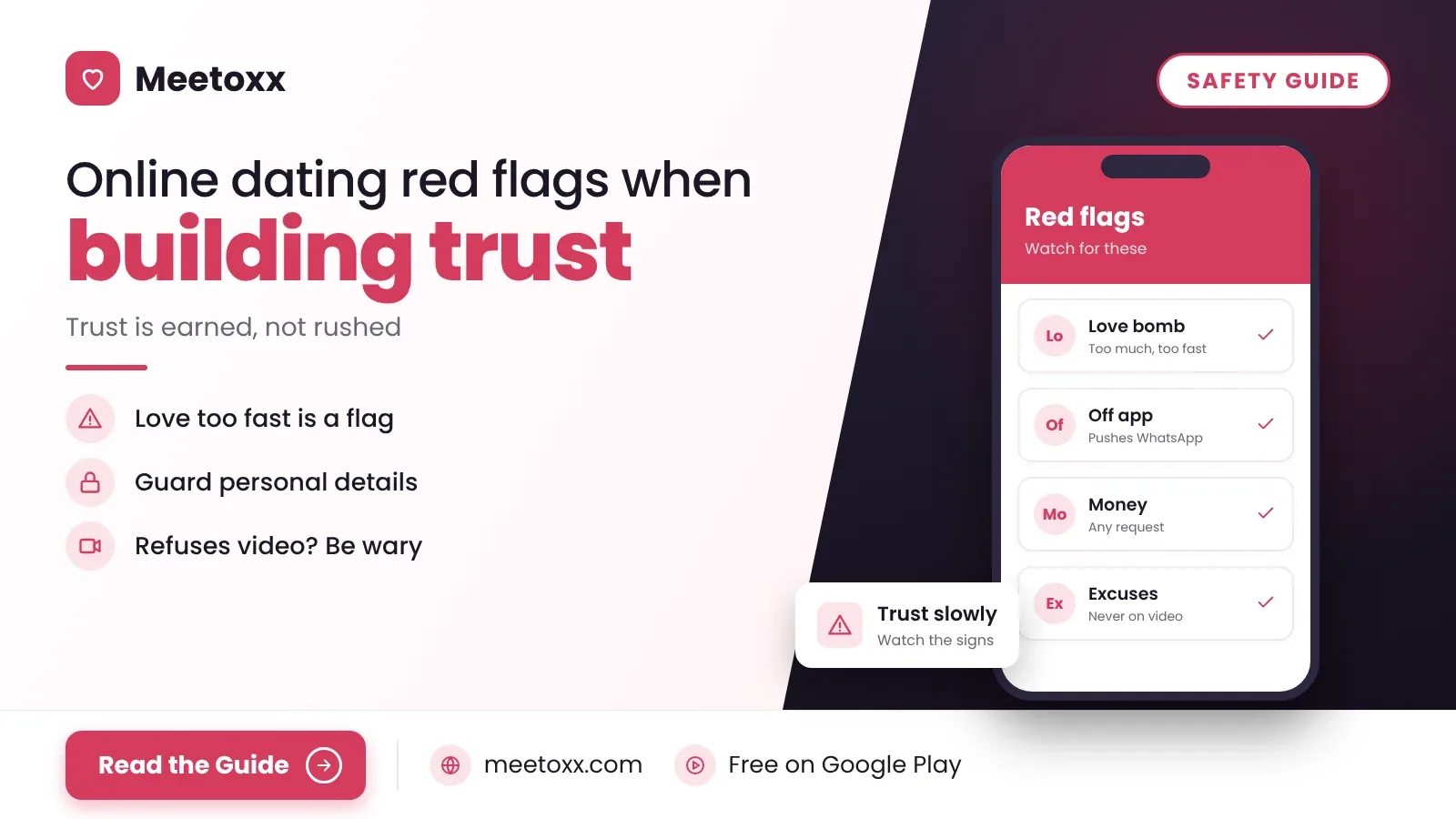
The most important online dating red flags are behavioural rather than visual: someone who moves too fast emotionally, avoids live calls, keeps their life vague, tries to isolate you from friends or the app, and eventually brings up money. Real trust online grows slowly through consistency, honesty and respect for your boundaries. If a connection is speeding past those steps, that speed is itself the warning sign. This guide focuses on how people talk and behave, and on how money scams typically unfold, so you can recognise the pattern early.
How trust normally grows
Before looking at red flags, it helps to know what healthy looks like. In a genuine connection, trust builds in small, ordinary steps:
- Light conversation becomes more personal over days or weeks, not hours.
- Both people share details about their lives, at a similar pace.
- A voice or video call happens fairly naturally.
- Plans to meet are made, and kept, in a public place.
- Boundaries are respected without argument.
Keep this picture in mind. Online dating red flags are mostly moments when someone tries to skip or rush these steps.
Conversational online dating red flags
Pay attention to how someone talks, not just what they say:
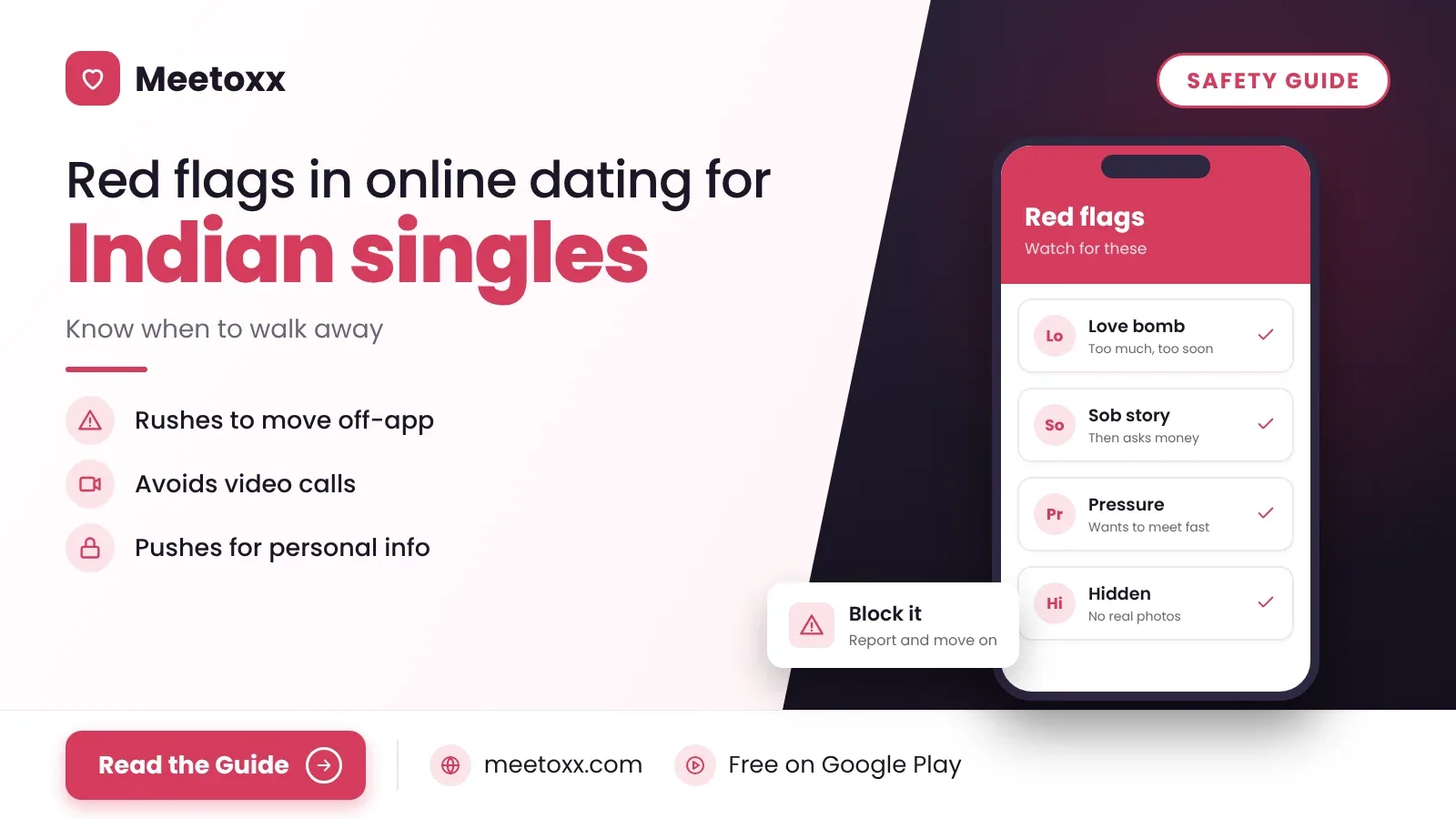
- Love-bombing. Intense compliments and declarations such as 'you're my soulmate' or 'I've never felt this way' within days. Flattering, but a classic manipulation tactic.
- Scripted or inconsistent replies. Messages that ignore your questions, feel copied, or change tone sharply, which can suggest more than one person or a script.
- Vague about their own life. They ask many questions about you but give few specifics about their job, city or daily routine.
- Big future talk too soon. Marriage plans, house hunting or moving countries discussed before you have even spoken on a call.
- Sob stories. A steady stream of hardships, such as a sick relative, a stolen wallet, or a stuck business deal, that invite your sympathy.
- Disrespect for 'no'. Sulking, guilt-tripping or anger when you decline a request or set a boundary.
Behavioural red flags
Some warning signs show up in actions rather than words:
- Pushing you off the app fast. Insisting on WhatsApp or Telegram within the first few messages removes the app's reporting tools and gives them your number.
- Always unavailable for calls. Broken camera, bad network, night shifts, overseas postings. Once is life; every time is a pattern.
- Cancelled meetings. Plans to meet that always fall through at the last minute.
- Isolation. Telling you not to discuss them with friends or family, or saying others 'won't understand'.
- Secrecy and urgency. Anything framed as 'just between us' and 'it must be today'.
- Pressure for photos. Requests for intimate images or videos, which can be used for blackmail.
How money scams usually unfold
Romance and money scams vary, but many follow a similar arc. Recognising the stages helps you step out early. If you have ever searched 'how to know if someone online is scamming you', this is the answer; the same pattern shows up as matrimony fraud and dating app scams in India, the UK, the Gulf and elsewhere:
- The hook. An attractive, often impressive profile: a doctor abroad, an engineer on a ship, a successful business person.
- Fast closeness. Daily good-morning messages, long chats and talk of a future together.
- The move. A shift to a private messaging app 'for convenience'.
- The test. A small request, such as a phone recharge or a gift card, to see whether you will pay.
- The crisis. A bigger emergency: customs fees on a gift parcel, a medical bill, a frozen account, legal trouble, or a flight ticket to come and see you.
- The investment pitch. Sometimes, instead of a crisis, an offer to teach you crypto or trading on a platform they recommend, which is designed to take your money.
- The escalation. If you pay once, requests usually grow, often with guilt or threats if you hesitate.
The rule is simple: never send money, gift cards, crypto or bank details to someone you have only met online, however real the relationship feels. No genuine partner will ask that of you early on.
Green flags worth noticing
It is just as useful to recognise good signs:
- They happily agree to a video call and look like their photos.
- Their stories stay consistent over time.
- They respect your pace and your boundaries.
- They are comfortable with you telling friends or family about them.
- They suggest meeting in a public place and do not mind you arranging your own transport.
- Money never comes up.
What to do if you spot online dating red flags
You do not need proof to protect yourself. If something feels wrong:
- Pause and stop sharing personal information.
- Ask for a video call. A genuine person will usually agree.
- Talk it over with a trusted friend; an outside view often spots what we miss.
- Block and report the account on the app.
- If you have already sent money or shared bank details, contact your bank immediately and report the fraud to your local cybercrime authority.
Feeling embarrassed is common, but scammers are skilled and target kind, trusting people. Reporting helps protect others too. More advice is on our trust and safety page.
How Meetoxx supports safer trust-building
Meetoxx is designed so you can build trust without giving too much away too soon. Every profile passes a quick selfie check before it can send a message. You can chat, send voice notes and make HD video calls free inside the app, so there is no need to share your phone number or move to another app early, and messages are encrypted. If someone shows red flags, you can block or report them in one tap, and the team reviews every report.
Find out more about free in-app chat and free video call app. Meetoxx is free on Android: get it on Google Play.
Trust is earned, not rushed
The best protection is a steady pace. Let conversations deepen naturally, move to video early, keep chats on the app until you are sure, meet in public, and treat any mention of money as a stop sign. Genuine people will match that pace, and the ones who will not are telling you something important.