Why Dating App Verification Matters: The Truth Behind Blue Ticks
A blue tick tells you something real, but not everything. Here is what dating app verification checks, where it stops, and how to use it well.
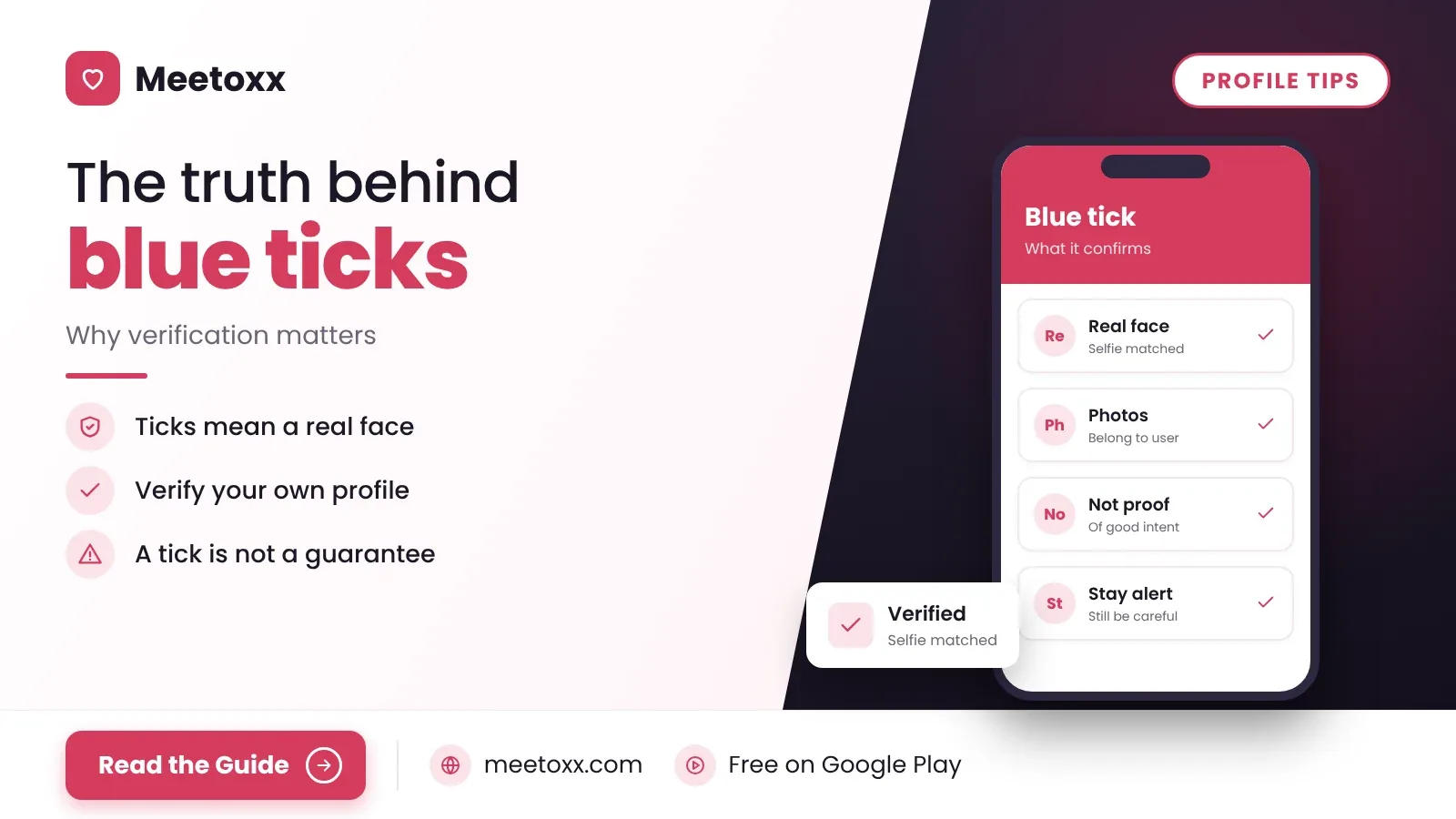
Dating app verification matters because it raises the cost of pretending to be someone else, but a blue tick only proves what the specific check tested. A selfie check usually confirms that a real person who resembles the profile photos created the account at a certain moment. It does not prove their age, job, marital status, income or intentions. Treat a badge as a useful first filter, not a character certificate, and keep using your own judgement after you see it.
What dating app verification actually checks
Across dating and matrimony apps, 'verified' can mean very different things. Common methods include:
- Phone number verification: a one-time code proves the person controls a phone number. Easy to pass with any SIM.
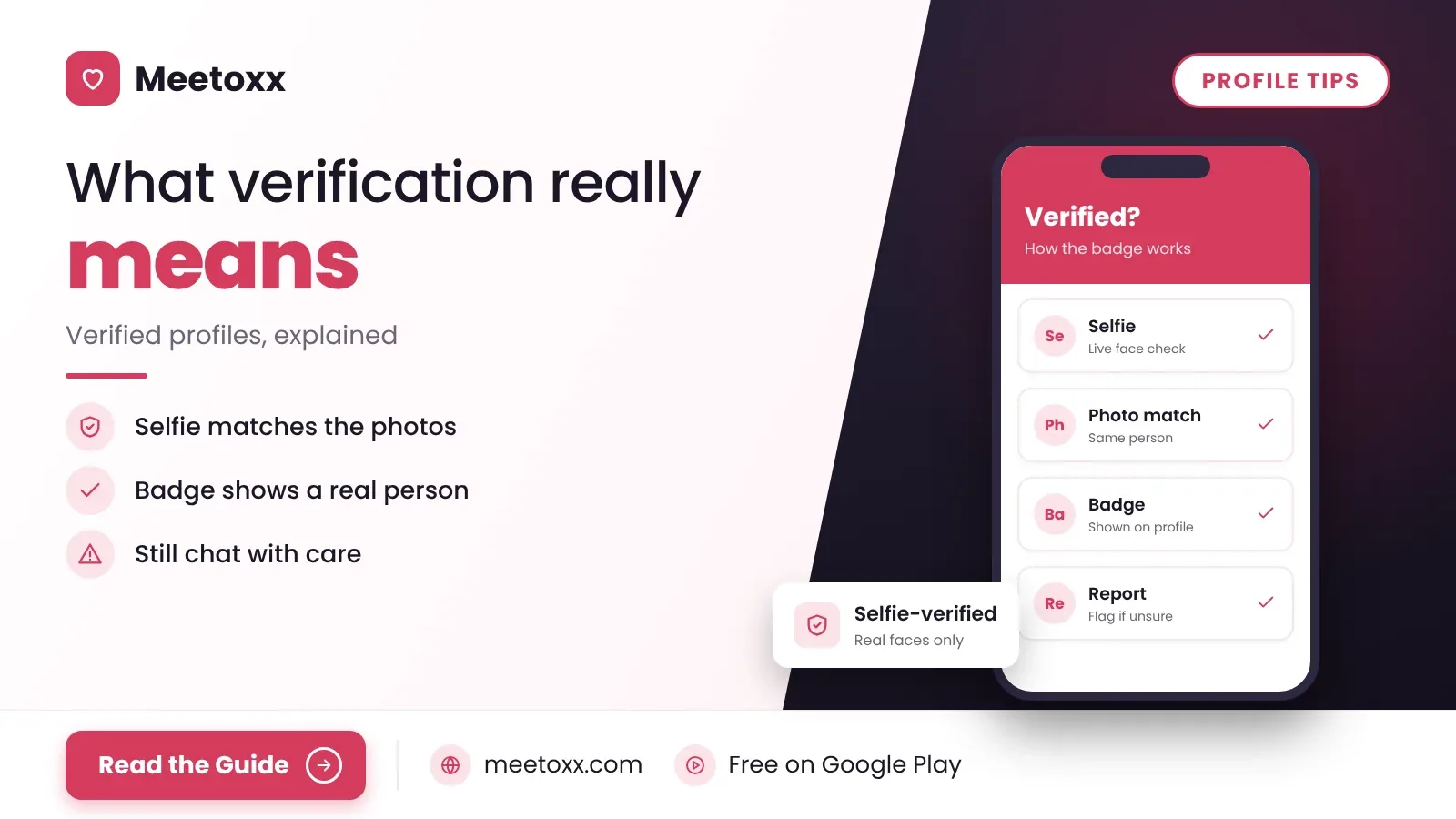
- Selfie or photo verification: the user takes a live selfie, sometimes copying a pose, and it is compared with their profile pictures by software, a human reviewer or both.
- Government ID verification: the user uploads an ID document, which may be matched against a selfie. Some apps offer this in certain countries only.
- Social or email linking: an account is tied to an email address or a social profile, which adds a small layer of accountability.
Apps such as Tinder, Bumble and Hinge have offered photo verification in various forms, and Indian matrimony sites like Shaadi.com, Jeevansathi and BharatMatrimony have used ID-based or document checks for some members. Features change often and vary by country, so check the app itself to see exactly what its badge means today.
What a blue tick can tell you
A well-designed photo check answers one important question: is there a real human behind this profile who looks like these photos? That single answer filters out a lot of problems:
- Accounts using stolen pictures of models or influencers.
- Bulk-created bot profiles that are run by scripts.
- Many casual catfishers who are not willing to show their own face.
Verification also changes behaviour. When people know their face is linked to their account, many become more careful about how they speak and act. That is part of why apps invest in it.
What a blue tick cannot tell you
This is where people get caught out. Even a strong verification process usually does not confirm:
- Marital status. A real face does not mean a single person.
- Age, unless ID is checked. And even ID checks have limits.
- Job, education or income. These are almost always self-reported.
- Location right now. A person verified in one city may be somewhere else today.
- Intentions. A verified person can still be dishonest, manipulative or a scammer.
- Who is using the account later. A check happens at one moment; an account can be shared or handed over afterwards.
In short, verification confirms identity signals, not honesty. The worst mistake is relaxing your guard because you saw a tick.
Why badges still matter so much
If badges cannot prove everything, why care? Because safety online is about layers. Each layer removes some risk, and together they make bad actors' lives much harder. Good dating app verification removes the easiest form of fraud, which is pretending to be a different person entirely. That pushes would-be scammers into riskier territory, where they have to show their real face and talk live. Combined with in-app calling, reporting tools and your own checks, the result is a noticeably safer experience than an app with no checks at all.
Verification also helps honest people. If you are genuine, a badge lets matches skip some of the suspicion and get to real conversation faster.
Paid badges versus safety checks
On some social platforms, a blue tick has at times been tied to a paid subscription rather than identity confirmation. That has confused many people about what a tick means. On a dating or matrimony app, ask yourself whether the badge came from a safety check or from buying a premium plan. Read the app's help pages; if it is unclear, assume the badge proves less, not more. Pricing and badge rules change, so check current details on each app.
If you have searched 'what does a blue tick mean on a dating app', 'is a verified profile safe' or 'selfie verification vs ID verification', the honest answer is the same: a badge is a good sign, never a guarantee.
How to read a verified profile wisely
When you see a verified badge, use it as permission to start a conversation, then keep checking with simple steps:
- Compare the photos with the video call. Ask for a short video call before meeting. It confirms what the badge suggests, live.
- Check consistency over time. Does their story stay the same across chats?
- Keep personal details private. Do not share your phone number, address or workplace until you have real trust.
- Never send money. No verified badge makes a request for money safe.
- Meet in public and tell a friend. Share where you are going and who you are meeting.
How dating app verification works on Meetoxx
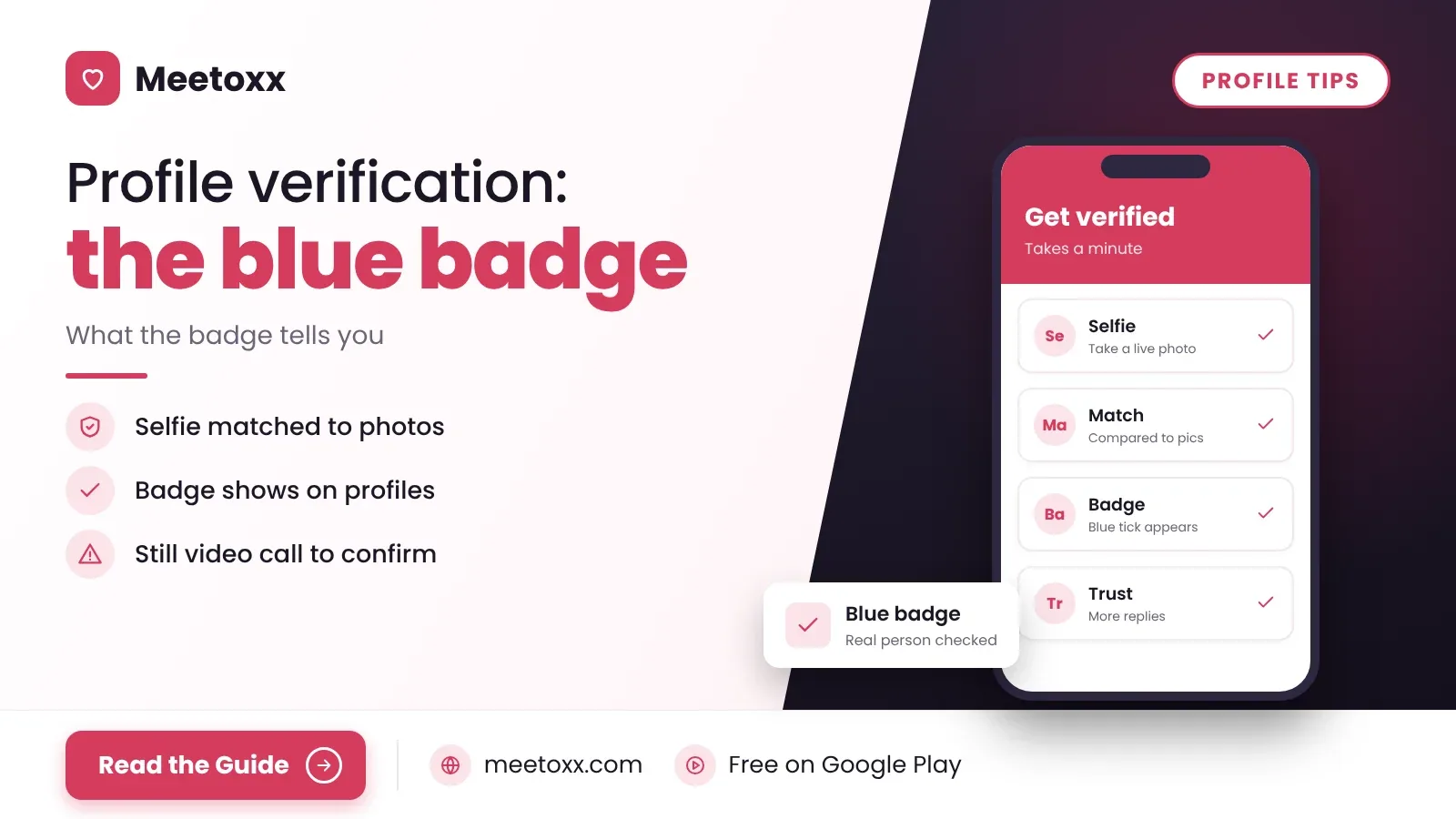
Meetoxx uses a simple rule: verified before contact. Every profile passes a quick selfie check before it can send a message, so you are not receiving messages from faceless accounts. It takes under a minute when you create your profile.
The app is built so that the badge is one layer among several. Your phone number stays private while you chat, send voice notes and make HD video calls inside the app, and messages are encrypted. You can block or report anyone in one tap, and the team reviews every report. Everything is free, so the badge is never something you buy, which matters if you are looking for a free verified dating app rather than a paid tick. You can read more on our trust and safety page, or see how free in-app video calls make the live check easy. Like any app, Meetoxx's check confirms a real face, not someone's whole life story, so the tips above still apply.
If you want to try it, Meetoxx is free on Android: download from Google Play. You can also start by browsing the free dating app overview.
The bottom line on blue ticks
A blue tick is a promise about one specific check, not about the person. Find out what the check is on the app you use, appreciate what it filters out, and keep your own simple habits: video call first, stay inside the app until trust is earned, meet in public, and never send money. That combination protects you far better than any badge on its own.