Cultural Compatibility in Marriage: What Really Matters Day to Day
Culture is not just community or religion. It is food, festivals, family roles and money habits. What to talk about before you commit.
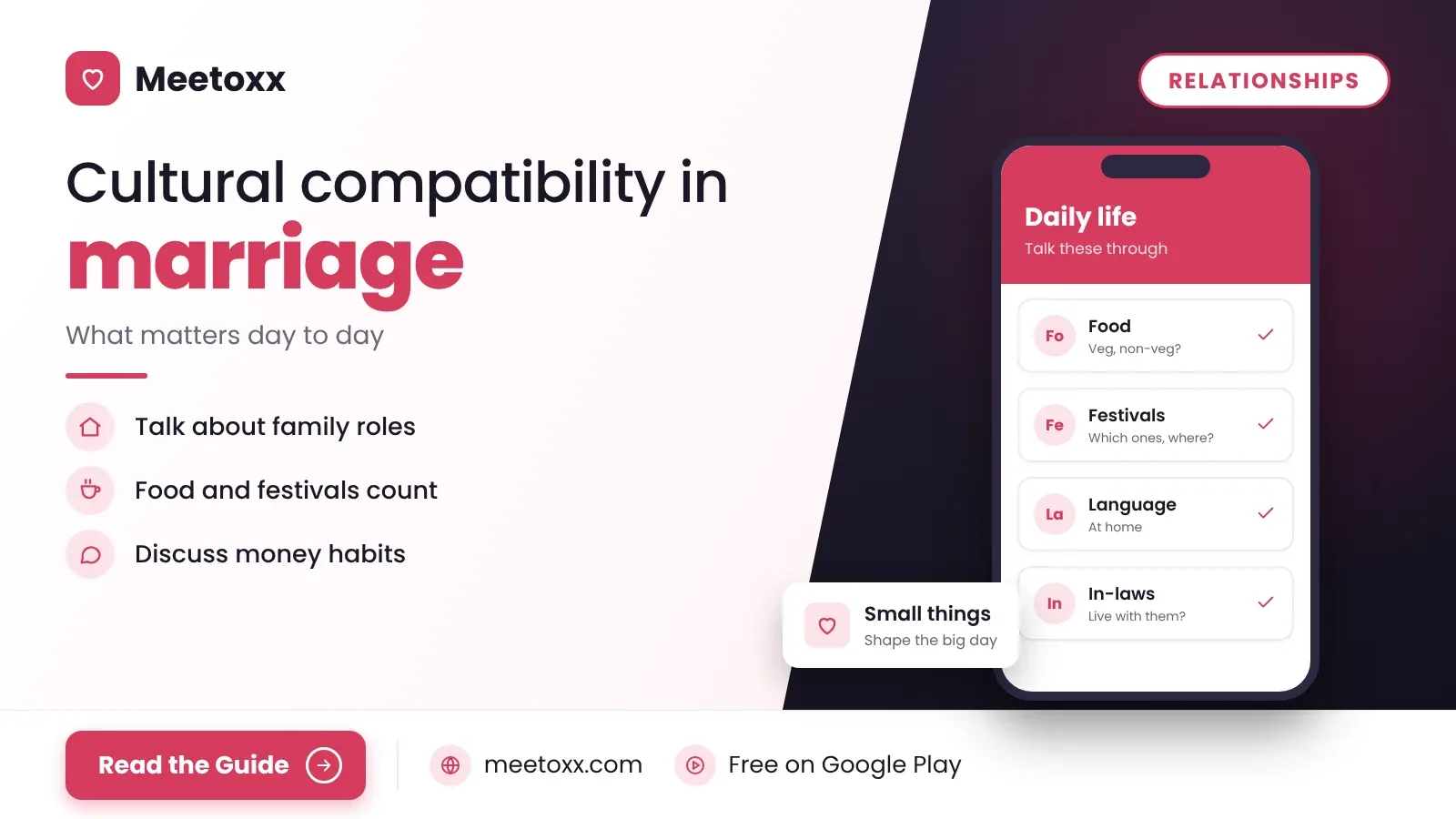
Cultural compatibility in marriage is often discussed as a question of community, but daily life tells a fuller story. When people say "cultural compatibility", they often mean community or religion. But culture shows up in smaller, daily ways that matter just as much once you are married.
The everyday things that cause friction
- Food. Vegetarian or not, onion and garlic or not, who cooks and when.
- Festivals. Which ones you celebrate, where, and with whose family.
- Family roles. Living with parents or separately, how often you visit, who makes decisions.
- Money. Saving vs spending, supporting parents, joint or separate accounts.
- Language. Which language you speak at home and with future children.
Same background does not guarantee a match
Two people from the same community can have very different habits, and two people from different backgrounds can fit easily. What matters is whether you can talk about differences openly.
Questions worth asking before you commit
- How did your family celebrate festivals, and how would you like to?
- Where do you see us living in five years?
- How do you feel about supporting parents financially?
- What does a normal Sunday look like for you?
When backgrounds differ
Many couples blend traditions: Diwali at one home, Eid or Christmas at the other, two languages for the children. It works best when both families feel respected and nobody is asked to give everything up.
If you are looking for someone serious, Meetoxx is free on Google Play, every profile is phone-verified by OTP, and you can video call inside the app before you share your number.
Quick answers
Does cultural compatibility matter in marriage?
Yes, especially everyday habits such as food, family roles and money. Open conversation matters more than identical backgrounds.
Can couples from different cultures be happy?
Yes. Many blend traditions successfully when both families feel respected.
How to talk about cultural compatibility in marriage before the wedding
Knowing that culture matters is the easy part. The harder part is starting the conversation without it sounding like a test. A practical approach is to talk through an ordinary week together rather than asking abstract questions. Ask what a normal Sunday looked like in their home growing up, who cooked, who decided where the family went and how money for festivals was handled. These stories reveal far more than a yes or no answer about religion or caste, and they rarely feel confrontational.
It helps to treat differences as information, not as a verdict. Two people can come from the same city and community and still have very different expectations about how often parents visit, whether the wife keeps working after children, or how loudly disagreements are allowed to happen. Equally, two people from very different backgrounds can discover that their everyday habits fit together surprisingly well.
Five areas worth discussing early
- Food at home: vegetarian or not, who cooks, what happens when in-laws visit, and how strict either of you is about it.
- Festivals and rituals: which ones you celebrate, at whose house, and how much time and money they usually take.
- Family roles: how involved each set of parents expects to be, and where you would live after marriage.
- Money habits: saving, spending, supporting parents and giving gifts at family events.
- Language: what language you would speak at home and with future children.
Bringing families into the conversation
In many Indian families, the couple agrees first and then has to bring both households along. It helps to agree between yourselves on what is non-negotiable and what is flexible before parents are involved. Present a joint view, explain the compromises you have already discussed and let each partner speak to their own family first. Our guide on talking to your family about online matrimony covers how to handle that first conversation, and talking to parents about an intercaste marriage goes deeper where communities differ.
When differences feel too big
Some gaps are worth taking seriously. If one person expects the other to give up their faith, language or career entirely, or if either family refuses to treat the other with basic respect, those patterns often grow after the wedding rather than shrink. It is better to pause and talk honestly, perhaps with a counsellor or a trusted elder, than to hope the problem fades on its own.
Meeting people whose values fit yours
If you are still searching, it is easier to find a good fit when profiles are honest about intent and lifestyle. On Meetoxx you can filter by city, intent and language, every profile is selfie-verified before messaging, and you can chat, send voice notes or make free HD video calls while your number stays private. Video calls in particular help you hear how someone talks about family and food before anyone books a meeting. You can browse options through the Meetoxx matrimony pages for your city.
Is it possible to build compatibility over time?
Yes, to a large extent. Many couples start with different habits and slowly create a shared household culture of their own: a mix of both families' festivals, a food routine that works for both, and a way of handling parents that feels fair. What makes this possible is not identical backgrounds but a shared willingness to listen, adjust and keep talking when something feels uncomfortable. If both of you can name your expectations honestly and treat each other's families with respect, differences become something you manage together rather than something that divides you.