Buddhist Matrimony: Find a Verified Buddhist Match
A respectful guide to Buddhist matrimony across India's diverse Buddhist communities, with tips on profiles, family conversations and finding a verified match safely.
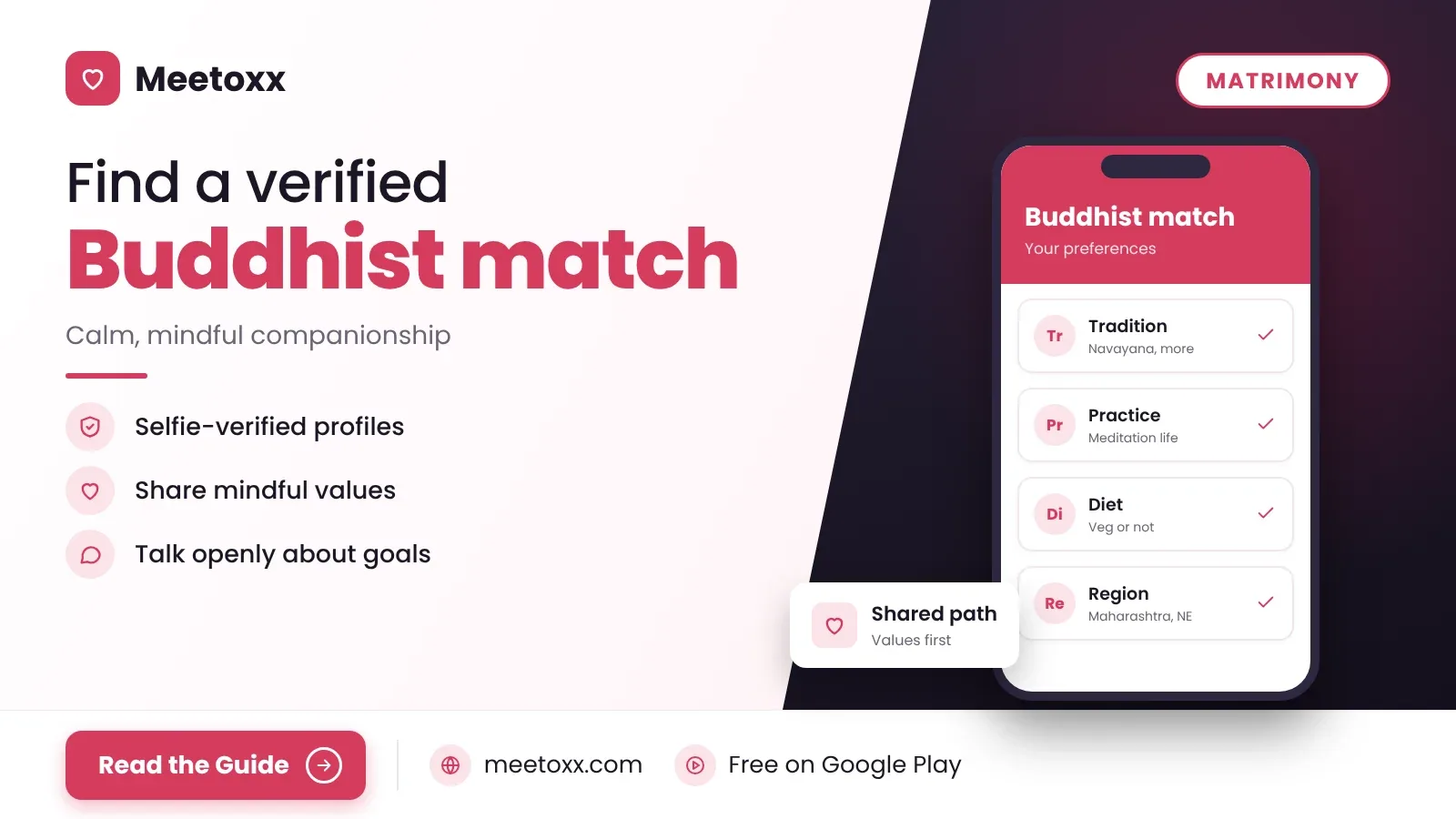
Buddhist matrimony covers a wonderfully varied set of communities, from Ambedkarite Buddhists in Maharashtra to Himalayan Buddhists in Ladakh and Sikkim, and Buddhist families across the North-East, West Bengal and the global diaspora. Because Buddhism does not prescribe a single marriage ritual, finding a verified Buddhist match is mainly about shared values, compatible family customs and honest conversation, supported by a platform that verifies people before they can contact you. This guide explains what to consider and how to search well.
Many Buddhist communities, one shared path
India's Buddhist population is diverse. Much of it traces its modern identity to Dr B. R. Ambedkar, who embraced Buddhism at Deekshabhoomi in Nagpur in 1956 along with a very large number of followers; his Navayana Buddhist movement remains strong in Maharashtra and beyond. In the Himalayas, communities in Ladakh, Sikkim, Arunachal Pradesh, parts of Himachal Pradesh and the Darjeeling hills follow Tibetan Buddhist traditions, and Tibetan communities live in places such as Dharamshala and Bylakuppe. Theravada traditions are followed by communities such as the Barua and Chakma in the North-East and West Bengal.
These communities differ in language, food, festivals and wedding customs. A Marathi-speaking family in Nagpur and a Sikkimese family in Gangtok may both be Buddhist yet have very different expectations. Naming your community, language and region gives matches a much clearer picture.
What a Buddhist wedding can look like
Buddhism treats marriage largely as a social and family matter rather than a religious obligation, so ceremonies vary widely and tend to emphasise simplicity and mutual responsibility.
- Ambedkarite weddings are often held in front of images of the Buddha and Dr Ambedkar. Guests commonly recite the Tisarana (Three Refuges) and the Panchsheel (Five Precepts), the couple take vows, and the ceremony is often led by a bhante or a respected community member. Many families favour modest weddings over expensive ones.
- Himalayan and Tibetan Buddhist weddings may involve auspicious dates chosen with the help of a lama, prayers, the offering of khatas (ceremonial scarves) and family feasts, with customs varying by region.
- Theravada communities may invite monks to chant blessings and receive offerings, sometimes before or after the main wedding celebration.
In India, marriages of Buddhists are generally governed by the Hindu Marriage Act, which legally covers Buddhists, and couples can also choose the Special Marriage Act. Registering your marriage is wise in either case.
Values worth talking about
Buddhist teaching places weight on kindness, right speech, honesty and mutual respect, and these make a good basis for early conversations. Useful questions include:
- How do you practise: meditation, vihara or gompa visits, observing Buddha Purnima or Losar?
- Do you follow the Five Precepts closely, including views on alcohol?
- Are you vegetarian, or does your family eat meat?
- How involved is your family in the community or in social causes?
- Would you be comfortable with a partner from another Buddhist tradition, or another faith?
- Where do you plan to live, and with whom?
For many Ambedkarite families, a commitment to equality and education is central, and many people look for a partner who shares that outlook. Bringing it up openly is a strength, not a risk.
A profile that reflects who you are
Keep it truthful and specific. Mention your community and language, how you practise, your education and work, and your family set-up. Say clearly whether you are looking only within your community or are open more broadly. A recent, clear photo and a short, sincere description of what you hope a marriage will feel like will draw better replies than a long list of requirements.
Buddhist matrimony near me: where to search
Maharashtra has one of India's largest Buddhist populations, so Buddhist matrimony in Nagpur, Mumbai matrimony, Pune and Thane are natural places to start. Himalayan and North-Eastern Buddhist families are often spread between their home states and big cities such as Delhi, Bengaluru and Kolkata for work and study. Abroad, many Indian Buddhists live in the US, the UK, Canada and Australia, and cities such as Singapore matches and Kuala Lumpur have long Buddhist traditions of their own. Begin from the matrimony by city and filter by language and city.
Staying safe
Right speech applies online too, but not everyone follows it. Protect yourself with simple habits:
- Never send money to someone you have not met in person, however urgent their story sounds.
- Video call before meeting, and involve family on a call when things become serious.
- Be careful with anyone who refuses to show their face or pushes for quick commitment.
- Meet first in a public place, tell a friend or relative, and arrange your own travel.
Free Buddhist matrimony with verified profiles
Meetoxx is a free dating and matrimony app, and its matrimony mode is designed for serious, family-friendly matchmaking by community, language and city. Every profile passes a quick selfie check before it can send a message, so you know the person writing to you is real. Chat, voice notes and HD video calls stay in the app, so your phone number remains private, and you can block or report anyone in one tap; the team reviews every report.
There are no credits, paywalls or limits on video call minutes. Meetoxx is available in 45+ countries and you can get it on Google Play.
Simplicity, kindness and honesty
The Buddhist approach to marriage tends to favour substance over show. Look for a partner whose everyday kindness you trust, speak honestly about your hopes and your family, and let the relationship grow at its own pace.