Best Dating App on the App Store & Play Store: How to Choose
Store rankings only tell part of the story. A practical checklist for finding the best dating app on the App Store or Google Play, from cost and safety to intent.
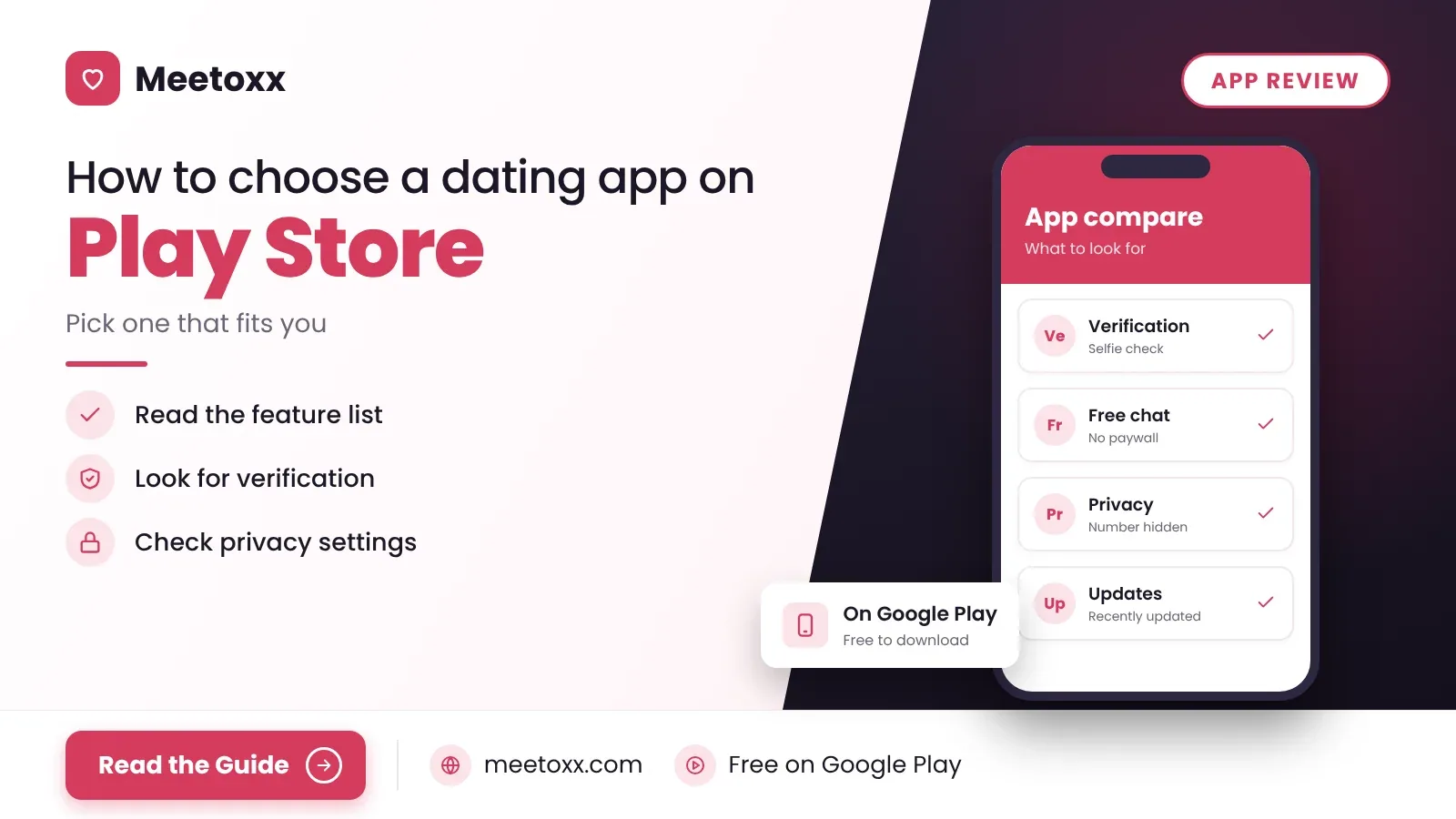
The best dating app is the one that matches your goals, your budget and the people in your area, not necessarily the one at the top of a store chart. Rankings on the App Store and Google Play reflect downloads and ratings, which are useful signals but can hide important details such as paywalls, fake profiles or a mismatch in what users are looking for. This guide gives you a practical way to compare apps on either store, explains what to look for in a listing, and is honest about where Meetoxx fits, including the fact that it is currently on Google Play only.
Start with what you actually want
Before you compare a single app, answer three questions for yourself.
- What is my intent? Casual dating, a long-term relationship or marriage. Different apps attract different crowds.
- Who am I hoping to meet? Someone nearby, someone who shares your language or community, or someone in another city or country.
- What am I willing to spend? Nothing at all, a little for convenience, or a regular subscription.
Your answers narrow the field quickly. An app that is perfect for casual matches in a big city may be a poor fit for someone looking for a marriage partner from a particular community.
How to read a store listing properly
Store pages tell you more than the star rating if you know where to look.
- In-app purchases: both stores show whether an app has paid features. Scroll down to see typical price points and check current pricing inside the app.
- Recent reviews: sort by most recent rather than most helpful. They show how the app is working now, not two years ago.
- Patterns in complaints: one angry review means little, but many mentioning fake profiles, surprise charges or slow support is a signal.
- Developer replies: an active team that responds to problems is a good sign.
- Privacy and data safety section: both stores now summarise what data an app collects and how it is used.
- Update history: regular updates suggest an app is maintained and improving.
The comparison checklist
Once you have a shortlist, compare each app on the same points.
Cost: is it really a free dating app?
Can you message and reply without paying? Are likes limited? Are calls free? Many popular apps, including Tinder, Bumble and Hinge, use a freemium model where core features are free and extras are paid. Others are free throughout. Plans change often, so verify before you commit.
Verification
Does the app check that people are real? Options range from phone number checks to photo or selfie verification. The stronger the check, the fewer fake accounts you are likely to meet.
Privacy
Can you chat and call without giving out your number? Can you control who sees your profile? These matter most once you start talking to strangers.
Safety tools
Look for easy block and report options and a clear statement about how reports are reviewed.
Filters and intent: dating or marriage
Can you filter by city, language, interests or relationship goals? Can you signal whether you want dating or marriage?
Communication features
Text only, or also voice notes and video calls? Video in particular helps you confirm someone is genuine before meeting.
Who uses it near you
The finest features mean nothing if nobody nearby is active. Try an app for a week or two before judging it.
App Store versus Play Store: does it matter?
For most big international apps, the experience is similar on both platforms. A few things are worth knowing, though.
- Availability differs. Some apps launch on one store first or remain on one platform only, especially smaller or regional apps.
- Pricing can differ slightly between platforms and countries because of store fees and local pricing.
- Subscriptions are managed separately. Cancelling on one platform does not cancel on the other, so check both if you switch devices.
- Your matches do not care. People on Android and iOS can generally match with each other on cross-platform apps.
Red flags in any dating app
- You cannot read or reply to messages without paying, but this was not clear upfront.
- Lots of matches that never reply or immediately ask you to move to another app.
- No visible way to report or block users.
- Profiles that look too polished, with no verification badge or check.
- Requests for money from matches. Never send money to anyone you meet online.
You can read more about staying safe on our trust and safety page.
Where Meetoxx fits
To be clear: Meetoxx is available on Google Play for Android. It is not on the App Store at the moment, so if you use an iOS device it is not an option for you right now, and the checklist above will help you choose among the apps that are.
For Android users, here is how Meetoxx answers the checklist. It is free throughout: profiles, chat, voice notes and HD video calls, with no credits, no paywall to read or reply and no minute limits on calls. Every profile passes a quick selfie check before it can send a message. Your phone number stays private because chats and calls happen inside the app, and messages are encrypted. You can block or report anyone in one tap, and the team reviews every report. Filters cover city, intent (dating or marriage), language and interests, and there is a dedicated matrimony side for family-friendly matchmaking. It is available in 45+ countries; see the free dating app page for more.
Choosing the best dating app for you
Pick two or three apps that fit your intent, read their store listings carefully, try them for a couple of weeks with a complete profile, and keep the one where you have the most genuine conversations. Combine that with sensible safety habits, such as video calling before you meet and meeting in public, and you will have found the best dating app for you. If you are on Android and want to try Meetoxx, it is on Google Play.